On the night of 26th Oct when most would be partying since it’s a weekend, I had enrolled for a stargazing session. Saturday noon I boarded a train from Ghatkopar to Atgaon (near Kasara) and reached Atgaon station at 2:30pm. The Stargazing mumbai representative guided us to the bus where we all assembled. It was a three hour bus ride which got bumpy as we approached the village roads. We reached the site – Samrad village, Bhandardhara at around 6 pm.
After registering, we were given red selofan paper to be put around our torches so that the harsh white light didn’t obstruct the viewing of the stars.
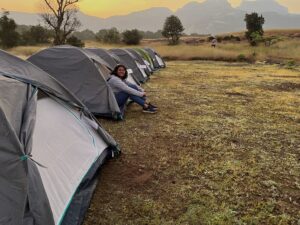
We settling in our respective tents, ate kanda bhaji prepared by the locals for snacks and assembled in the main ground for the session to begin. it was overwhelming to see a group of around 70 people.
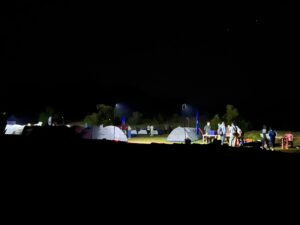
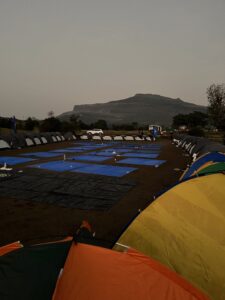
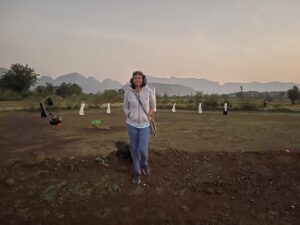
On one part of ground, about 8-10 telescopes were placed and in another part mats were placed on the floor . We lay down on the mats facing the sky. The session began at 8pm.
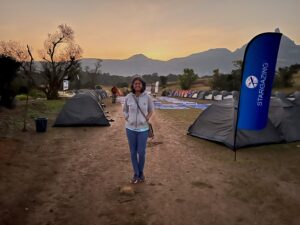
Once the session began the surrounding lights were shut. The complete darkness , gave a clearer view of the stars with the naked eyes . The Instructor Prof Mandar first gave us an understanding of the direction and movements of the stars . With the help of the laser light, he pointed at the different stars in the sky and formed shapes to give us an idea of the constellations and clusters . We also saw a part of the Milky Way . And then he pointed out the names of the different stars .
It was an enriching experience to know that the names of the stars were derived / connected to Greek and Hindu mythology . The instructor was pointing out the stars with the laser light and showed us the formation of the different sunsigns on the sky . So there was a lot of image formation through imagination that one had to do . Nothing short of an academic and immersive experience . The session was a mix of theory to give us a background of the stars and we saw them on the sky with naked eyes which was later followed by the observation of some of those stars through the telescope to get a closer look.
The Instructor Mr Aman gave us an insight into the invention , history of different telescopes and how it evolved over centuries. We were also shown the mechanism inside the telescopes.
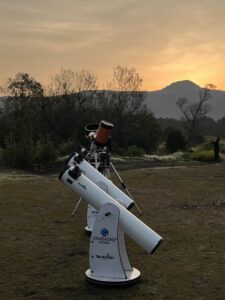
Below is the picture of a Catadioptric telescope
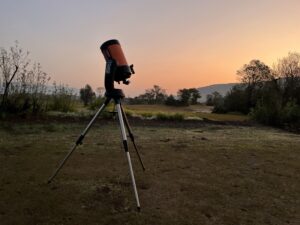
We started the observations through the telescope with watching Comet Tsuchinshan-ATLAS, also known as C/2023 A3, which is estimated to orbit the sun once every 80,000 years. We also saw the planet Venus ( which looked more like a dot / star) , Saturn and its ring , Jupiter with some of its moons surrounding it , the seven sisters constellation and a few others galaxies and constellations.
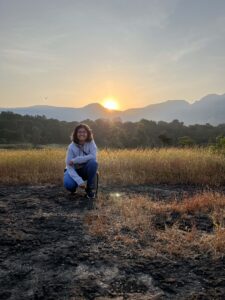
Next day morning , I took a walk around the place and enjoyed the view of the mountains and rising sun .
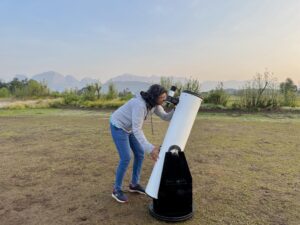
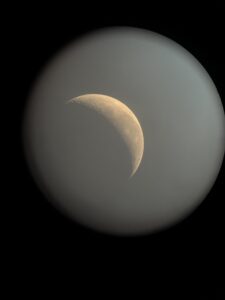
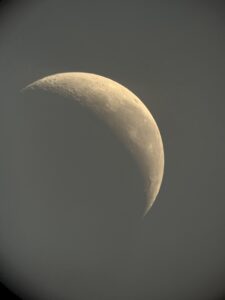
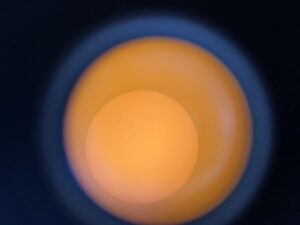
Just before sunrise through the telescope we saw the moon and it’s crators and also got a glimpse of the sun post sunrise.
A lot to absorb over a night but worth a try once in a lifetime , preferable in smaller groups.